White Elephant Statistics: How Long It Takes, How Often Gifts Get Stolen
Data from 840,000 simulated white elephant games across group sizes, steal rules and stealing styles. Published 2026-11-16, free to reuse under CC BY 4.0.
White elephant statistics, in short: with the common rule that a gift freezes after its third steal, a 20-player game averages 31.9 steals and about 34 minutes, and turn order barely matters. Remove the steal limit and the same game averages 83.2 steals and 51 minutes, and the last third of the draw ends with clearly better gifts than the first. Player 1's final swap turns the first number into the best seat at the table. Each figure below comes from 10,000 simulated games per configuration (840,000 in all), and the method, including what the model cannot know about your party, is at the bottom of the page.
Nobody has timed thousands of real gift exchanges, so planning advice about white elephant tends to be a guess repeated until it sounds like a fact. A simulation is not a measurement of real parties either, but it makes every assumption visible and lets you change one rule at a time: the same gifts, the same people and the same tastes, played under a two-steal freeze, a three-steal freeze, no limit, or one steal per turn. The differences between rules are the useful part. The rules themselves are explained on the white elephant rules page; this page is the numbers behind them.
How long white elephant takes, by group size
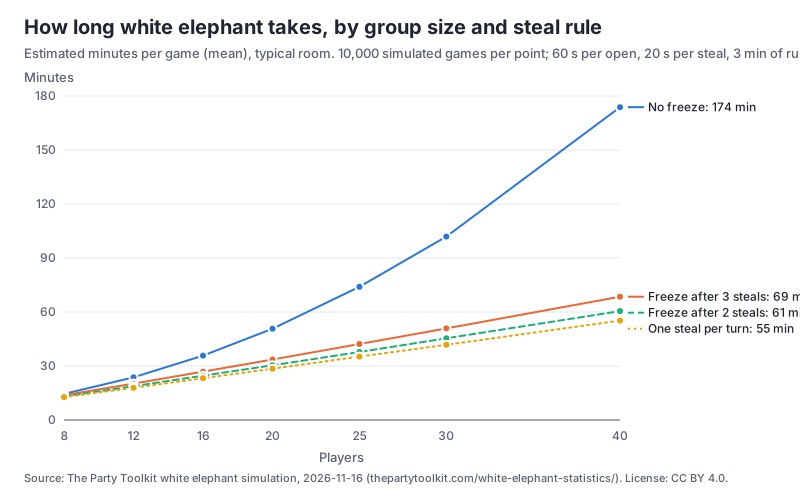
Game length is the number planners ask about most. The model counts every opened gift and every steal, then converts them to time at 60 seconds per opening and 20 seconds per steal, plus 3 minutes to explain the rules. The opening count is fixed (one per player), so all of the variation comes from steals. Each cell is the mean of 10,000 games in a typical room; the figure in brackets is the 90th percentile, a slow game you should still be able to fit.
| Players | Freeze after 3 steals | Freeze after 2 steals | No freeze | One steal per turn |
|---|---|---|---|---|
| 8 | 14 min (15) | 13 min (14) | 15 min (17) | 13 min (13) |
| 12 | 20 min (22) | 19 min (20) | 24 min (28) | 18 min (19) |
| 16 | 27 min (29) | 25 min (26) | 36 min (42) | 23 min (24) |
| 20 | 34 min (36) | 30 min (32) | 51 min (60) | 29 min (29) |
| 25 | 42 min (45) | 38 min (40) | 74 min (87) | 35 min (36) |
| 30 | 51 min (54) | 45 min (47) | 102 min (118) | 42 min (43) |
| 40 | 69 min (72) | 61 min (63) | 174 min (200) | 55 min (56) |
Two things stand out. First, every rule with a cap grows in a straight line: under a three-steal freeze, each extra player adds about 1.7 minutes, so 12 players need about 20 minutes and 30 players about 51. Second, the uncapped game does not grow in a straight line. Every new opening adds another gift that can be stolen, and every steal hands a turn to someone else, so steal chains get longer as the pile shrinks: 24 minutes at 12 players, 51 at 20, 102 at 30 and 174 at 40. That curve is the whole case for a steal limit.
Steals per game
The steal count is the raw output the minutes are built on, so it is the number to use if your group plays faster or slower than the timing assumptions. Each cell is the mean number of steals in a typical room, with the 90th percentile in brackets.
| Players | Freeze after 3 steals | Freeze after 2 steals | No freeze | One steal per turn |
|---|---|---|---|---|
| 8 | 8.5 (13) | 6.3 (9) | 10.5 (17) | 5 (7) |
| 12 | 15.6 (21) | 11.3 (15) | 26.2 (39) | 8.8 (11) |
| 16 | 23.6 (30) | 16.7 (21) | 50.3 (69) | 12.6 (15) |
| 20 | 31.9 (39) | 22.3 (27) | 83.2 (110) | 16.6 (19) |
| 25 | 42.5 (51) | 29.5 (35) | 137.9 (176) | 21.5 (24) |
| 30 | 53.6 (62) | 37.1 (43) | 206.7 (256) | 26.5 (29) |
| 40 | 76.5 (87) | 52.6 (59) | 392.4 (470) | 36.5 (38) |
Under a three-steal freeze, the longest chain of steals in a single turn averaged 6.1 at 20 players, against 10.3 with no limit. That one long turn is what people remember as "the game dragged". By the end of a 20-player game with a three-steal freeze, 9 of the 20 gifts were frozen on average, and the gift with the highest overall appeal was stolen 2.8 times and ended frozen in 90% of games. In other words, the best gift almost always runs its full course of three steals, which is the drama most groups want, and then leaves play.
Which number to draw: turn order statistics
Each player's final gift was scored against that player's own ranking of all the gifts in the game, as a percentile: 100 means they ended with their favorite, 0 with their least favorite, and 50 is a coin flip. The table splits the draw into thirds, for a 20-player game in a typical room.
| Rule | First third | Middle third | Last third | Player 1 used the final swap |
|---|---|---|---|---|
| Freeze after 3 steals | 63.3 | 63.8 | 65.6 | 57.5% |
| Freeze after 2 steals | 61.4 | 64.1 | 67.5 | 61.7% |
| No freeze | 59.1 | 65.4 | 78.8 | 95.3% |
| One steal per turn | 50.1 | 58.6 | 73.6 | 98.4% |
A freeze rule is a fairness rule as much as a time rule. With three steals per gift, the three thirds of the draw finish within 2.3 percentile points of each other. With no limit, the gap is 19.7 points, because late players can take whatever they like from a full table. One steal per turn is the least fair rule of the four (50.1 for the first third against 73.6 for the last), since early gifts get taken and their owners are forced back to the pile instead of stealing in turn.
Seat by seat, 20 players, three-steal freeze
| Number drawn | Average final percentile | Ended with one of their own top 3 gifts |
|---|---|---|
| 1 | 84.5 | 49% |
| 2 | 53.7 | 22.4% |
| 3 | 55.7 | 22.4% |
| 4 | 61.1 | 27.6% |
| 5 | 62.5 | 28.1% |
| 6 | 62.8 | 28.4% |
| 7 | 63.2 | 28.6% |
| 8 | 63.3 | 26.8% |
| 9 | 64.1 | 27.5% |
| 10 | 63.1 | 26.4% |
| 11 | 63.9 | 26.7% |
| 12 | 64.3 | 26.5% |
| 13 | 63.9 | 25.7% |
| 14 | 64 | 25.2% |
| 15 | 64.3 | 25.2% |
| 16 | 64.9 | 24.5% |
| 17 | 64.8 | 23.6% |
| 18 | 64.9 | 24.1% |
| 19 | 65.9 | 24.9% |
| 20 | 69 | 31.8% |
The final swap is a strong rule. Before it, player 1 averaged the 50th percentile, the same as a random gift. After it, the 85th, the best seat in the game, and 49% of player 1s ended with one of their own top three gifts against 22.4% for player 2. The losers are seats 2 and 3: they open early, get robbed, and the gifts they could have stolen back are soon frozen. If your group thinks the final swap is too generous, a milder version is to let player 1 swap only with gifts that have been stolen fewer than twice.
How much the stealing style matters
The biggest unknown is how willing your guests are to take a gift from someone. The model runs every configuration three times: a polite room that steals only for a clearly better gift, a typical room, and keen stealers who take anything they prefer to an unknown wrapped box. For 20 players with a three-steal freeze:
| Room | Steals per game | Minutes (90th percentile) | Player 1 used the final swap |
|---|---|---|---|
| Polite room | 22.6 | 31 (33) | 75.9% |
| Typical room | 31.9 | 34 (36) | 57.5% |
| Keen stealers | 40.2 | 36 (39) | 35.9% |
The steal count nearly doubles from polite to keen, but the minutes move by only 6 minutes, because openings, not steals, take most of the time once a freeze rule is in place. That is the practical takeaway for a host: with a cap, your guests' temperament changes the mood far more than the clock. Without a cap, it changes both.
What this means for planning a party
Use a three-steal freeze up to about 20 people and budget 36 minutes for 20. From 25 people, either drop to two steals (about 45 minutes for 30) or split into two circles with their own piles, which halves the wait for each player. Keep the final swap for player 1 if you want the first number to feel like a prize; drop it if you want every seat to be roughly equal. For the full rules, the house-rule table and the dice version, see the white elephant rules. To fill the rest of the night, the Christmas party games guide has a running order built around the exchange, the Minute to Win It Christmas games make a fast warm-up, and the New Year's Eve games guide covers the next party.
Methodology
The simulation is a script in this site's repository (scripts/white-elephant-sim.mjs), run on
2026-11-16 with a fixed random seed (20261116), so every number on this page reproduces exactly. Each game
gives every gift an overall appeal drawn from a normal distribution and gives every player a personal value
for every gift: the appeal plus a personal taste term (standard deviation 0.75). Players hold
numbers 1 to N and play the rules as written on our rules page: open a wrapped gift or steal an opened one,
a player who loses a gift chooses again, no immediate steal-backs, and player 1 gets one swap at the end
with any unfrozen gift if it beats their own. A player steals when the best gift they are allowed to take
beats the expected value of a wrapped gift by a margin: 1.0 for a polite room, 0.5 for a typical room, 0 for
keen stealers. The no-limit rule adds the common house rule that a gift can be stolen only once per turn,
which is what keeps a real uncapped game from looping forever. The one-steal rule makes the victim of a
steal open a new gift.
Seven group sizes (8, 12, 16, 20, 25, 30 and 40), four rules and three stealing styles make 84 configurations of 10,000 games each. Minutes are derived, not timed: openings at 60 seconds and steals at 20 seconds, plus 3 minutes of explanation. If your group takes two minutes per gift, rescale with the steal counts in the CSV.
What was not measured. No real party was timed or observed. The model does not know about friendships, couples protecting each other, revenge steals, people who refuse to steal on principle, gag gifts that are valued for the laugh, children, drinking, or a host who hurries things along. Gifts are valued independently, players know only that wrapped gifts are average, and nobody bluffs. Treat the minutes as a planning range and the comparisons between rules as the reliable part: the same assumptions apply to every rule, so the differences between rules hold even where the absolute numbers do not.
Download the data and reuse it
The full results, one row per configuration with 18 columns (mean, median and 90th percentile steals, minutes, longest chain, frozen gifts, final swap rate and turn-order percentiles), are in the white elephant simulation CSV. The chart is an SVG file you can embed as it is. Both are licensed CC BY 4.0: credit "The Party Toolkit" with a link to this page.
FAQ
How long does white elephant take with 20 people?
About 34 minutes with the common rule that freezes a gift after its third steal, and 36 minutes in a slow game (the 90th percentile of 10,000 simulated games). Without any steal limit the same group needs about 51 minutes.
How many steals happen in a white elephant game?
In the simulation, a 20-player game with a three-steal freeze averaged 31.9 steals, about 1.6 per player. A two-steal freeze cut that to 22.3, and no limit raised it to 83.2.
What is the best number to draw in white elephant?
Number 1, if your group plays the final swap. Seat 1 ended with a gift at the 85th percentile of the player's own preferences on average, against the 54th for seat 2, the worst seat, and the 69th for the last seat. Without the final swap, seat 1 would average the 50th percentile.
Does the steal limit make white elephant fairer?
Yes. With a three-steal freeze, the first, middle and last thirds of the draw ended at the 63rd, 64th and 66th percentiles, nearly level. With no limit, the last third reached the 79th percentile and the first third only the 59th.
Can I use these numbers and the chart?
Yes. The chart, the tables and the CSV are published under CC BY 4.0: use them anywhere, including commercially, with a credit and a link to this page.
More party tools
Never Have I Ever
Hundreds of Never Have I Ever questions by category, funny, couples, teens and more.
D&D Name Generator
Fantasy character names by race, elf, dwarf, orc, tiefling and beyond.
Would You Rather
Would You Rather questions from funny to extreme, ready for your next party.
Team Name Generator
Clever team names by sport and theme, trivia, softball, fantasy football and office.
Rapper Name Generator
Stage names by style, east coast, west coast, trap and old school.
Charades
Printable charades word lists by category and difficulty for all ages.